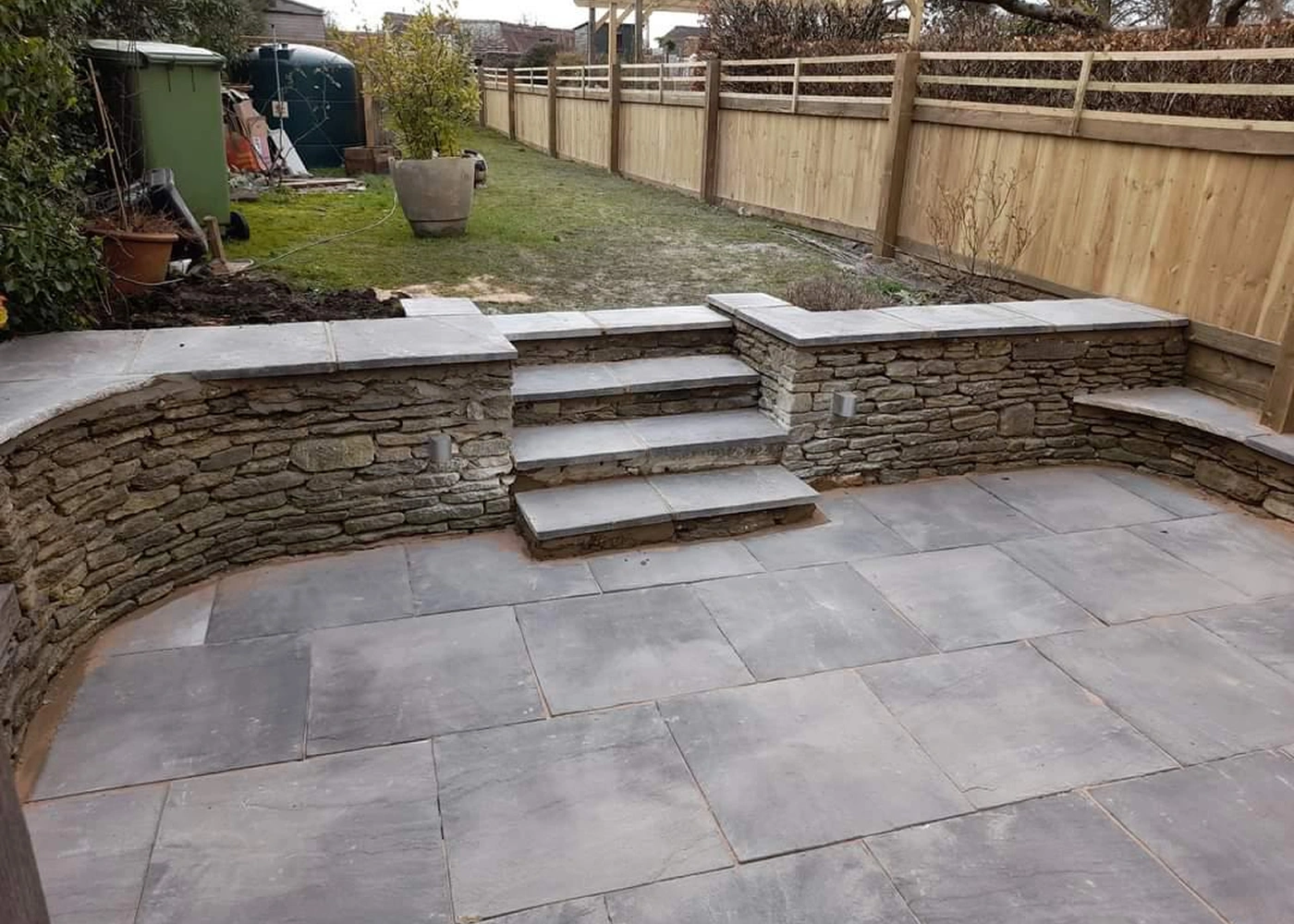
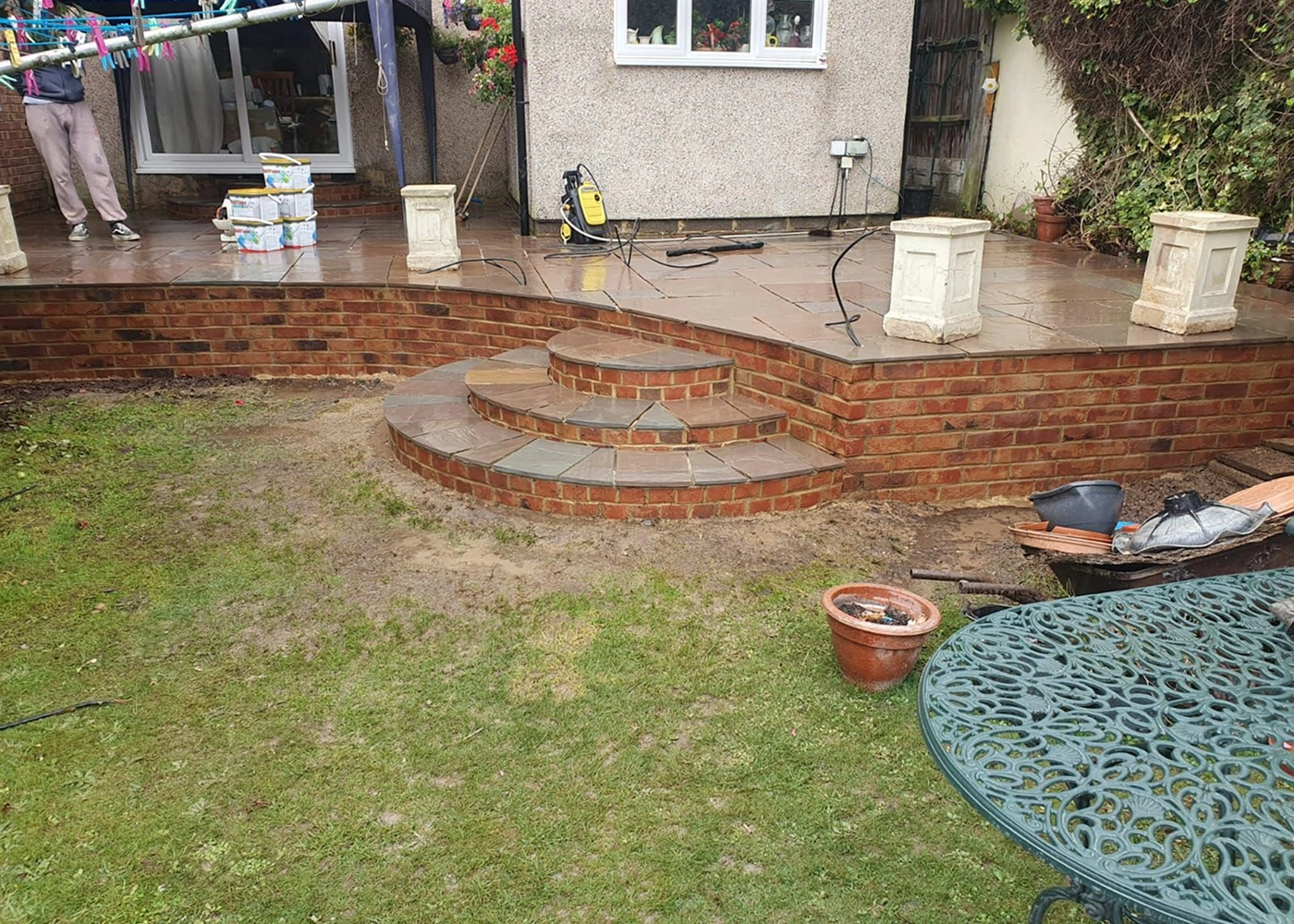
Porcelain and Indian sandstone are the two most popular choices for UK patios. Porcelain is the easier one to live with: it hardly absorbs water, resists stains and stays looking the same for years. Indian sandstone is a natural stone with more character and colour variation, but it needs sealing and more cleaning. The right choice depends on the look you want and how much upkeep you are happy with.
Side-by-side comparison
| Porcelain | Indian sandstone | |
|---|---|---|
| Look | Even colour and finish; many styles, including stone and wood effects | Natural, every slab different; riven (textured) or sawn (smooth) |
| Water absorption | Very low, so it resists stains, moss and frost | Porous; absorbs water and can stain or grow algae |
| Maintenance | Occasional sweep and wash | Regular cleaning; sealing recommended |
| Slip resistance | Depends on the tile; choose one rated for outdoor use | Riven finish gives good natural grip |
| Laying | Harder to cut; needs a bonding primer on the back of each slab | Easier to cut and shape; hand-cut slabs vary in thickness |
| Ageing | Changes very little over time | Weathers and softens in colour; some people love this |
Porcelain paving
Outdoor porcelain is made from fine clay fired at very high temperatures, which makes it dense and almost non-porous. Most outdoor slabs are around 20 mm thick. Because water can't soak in, porcelain resists stains from food, drink and barbecue fat, doesn't need sealing and stays clean with little effort.
The trade-offs: porcelain needs a diamond blade to cut, and each slab needs a slurry primer on the back so it bonds to the mortar bed. That makes it slower to lay. Check the slip rating before you buy, especially for shady areas or around steps. An R11 rating is commonly recommended for outdoor paving.
Indian sandstone
Indian sandstone is quarried natural stone, available in colours from greys to warm browns and multicolour mixes. A riven finish has a natural, textured surface with good grip; sawn sandstone has smooth faces and crisp edges for a more modern look. Calibrated slabs are cut to an even thickness, which makes laying more consistent than traditional hand-cut stone.
Because sandstone is porous, it can stain and turn green in damp, shady spots. A suitable sealant reduces this, and it needs cleaning more often than porcelain. Many people choose it precisely because it weathers and looks more natural with age.
Whichever you choose: lay it properly
Most patio problems come from the base, not the slabs. A well-built patio has:
- a compacted sub-base of crushed stone, so the slabs don't sink;
- slabs laid on a full bed of mortar, not dabs, to stop rocking and cracking;
- a slight fall away from the house so rainwater drains off;
- a finished level at least 150 mm below the damp-proof course of your house;
- properly filled joints to keep weeds out.
Paving in a front garden has its own rule: if you cover more than 5 square metres with a surface that doesn't let water through, and the water doesn't drain to a lawn or border, you need planning permission.
Which should you choose?
- Choose porcelain if you want a clean, modern look with the least upkeep, or the patio is next to a kitchen or used for dining and barbecues.
- Choose Indian sandstone if you prefer natural stone with character, have a traditional or cottage-style garden, or like paving that weathers over time.
Planning a new patio in South London?
Superior Landscaping builds gardens across Sutton, Wimbledon, Kingston and Wandsworth. See our garden landscaping service or get in touch for a free consultation, and we'll talk through the options for your garden.